Saturday, 17 May 2014

If only I could type up my conversations

Words are strange things.

When I'm sitting at my desk, fingers on the keyboard, it's like they're my best friends. I play with them, arranging and rearranging them in all sorts of interesting ways, till what I have is a story.

I think as a writer I'm not too bad. Maybe not to everybody's taste, but not too bad all the same. Within the context of writing, words and I seem to have a pretty good thing going.

But we don't always get on quite so well.

There are other situations where it's as if words don't like me at all. It's as if they exist solely to play tricks on me, and to trip me up. Those situations usually occur whenever I talk.

I'm absolutely terrible when it comes to talking. I open my mouth and I have no idea what is about to come out. In my mind, I have a perfect idea of what I want to say, but by the time the words are out, they often bear little resemblance to my original ideas. Other times, the word I want to say decides to disappear from my mind, leaving me tongue-tied and looking ridiculous. Sometimes, all that comes out is a garbled mess. At another times, nothing comes out at all. I just stand there, going "um, er, arrr," and various other unintelligible noises.

It's a real frustration, I can tell you. What is it about words that gives them such a Jekyll and Hyde personality, one minute so friendly and helpful and the next minute utter little devils? Whatever it is, it doesn't seem to be anything I've got any control over. Which, as a writer, is the biggest frustration of all.

I wish talking was more like writing. I wish, with every conversation I was involved with, I could take my time to craft the words I wanted to say. Maybe give them several drafts, as well as a final proof before I send them out into the world.

Seems like a nice dream, but I guess I'm stuck with reality. Time to get back to my computer, where I can get the words to do exactly what I want them to. And if you have something to say to me, I'm afraid the best I can manage in reply is "um, er, arrrr."

Saturday, 10 May 2014

Putting the dumb into Dumbledore

Okay, it's been a while since I did this, so today I'm going to have another go at piggybacking off the fame of a certain J.K. Rowling.

Before I start, I just want to clarify that I rather like the Harry Potter stories (although I do find some of the later ones somewhat bloated and in need of editing). I don't care so much for the films, but I've always been more of a book person so that's not surprising. So in case any Harry Potter fans want to take offense at this, I want to say that I'm totally with you guys. This is just meant to be a bit of fun.

The other thing I can say about myself is I have a background in academia (I know - scary but true). However, I don't have the academic's most basic calling card - the PhD. At various times, I have considered studying for one, but lots of reasons (mostly common sense) have prevented me. But in those moments of madness when I have considered it, one of the difficulties I have had is finding a suitable topic. Which takes us back to Harry Potter.

One of my PhD ideas was based on Harry Potter. It revolved around the fundamental premise that the only way the plots can work in these stories is if all the characters are stupid. I'll try to summarise it as follows:
  1. the kids are stupid, because they think they know who the villain us (usually Snape) but they always turn out to be wrong (how else can Rowling do her patented twist at the end).
  2. the villains are stupid - they're meant to be the most powerful evil wizards in the world, but they always end up getting foiled by a bunch of kids.
  3. the good adult wizards are also stupid - they never have the slightest idea what the evil wizards are up to, leaving Harry and his friends to solve (or mis-solve) the mystery while they stand around being wise and ineffectual (bit like that Jedi council in the Star Wars prequels - but that's a whole other universe of stupidity).
So there you have the basic premise. I even had a title for it - Putting the dumb into Dumbledore: the role of stupidity in the Harry Potter novels. I was pleased that I was able to include a colon, as a colon is a necessity when it comes to PhD titles (another PhD idea I had was the role of the colon in PhD titles).

And now, I suppose it's time to close my windows, lock my doors, and bunker down for the inevitable barrage from the Harry Potter world. Bring it on. I'm fully prepared to go first.

Saturday, 3 May 2014

The one thing above all that stops me writing

We writers face all sorts of obstacles.

I probably don't need to go into them in detail - but I will anyway because otherwise this is going to be a really short post.

There's the problems of finding the actual time to write. We're all faced with issues such as full time jobs, families, and other distractions tugging us away and severely limiting our writing time.

Then, when you actually get to sit at a computer, there are other problems. You're mind is constantly being pulled away by the delights of Facebook or Youtube or Twitter or the ridiculous variety of other social networky things. And even if we are gifted with iron will and concentration, and we manage to avoid the myriad of online temptations, we then have to battle sundry other writer's issues, such as writer's block and the general self-loathing feeling that what we are writing is just not up to scratch.

I regularly find myself face-to-face with all of these. But there's one other problem, one other issue beyond all others that has a massive impact on preventing me from getting my writing done.

I have trouble actually getting to my desk. 

Yes, it's true. On a basic physical level, it's almost impossible to get to my desk. You see, I write in my study, but it's not just my study. It also doubles as the place where everything in my house goes when it no longer has a place. Or it never had a place in the first place. Or it's in transition from one place to another. Or...I think you get the idea.

It's starting to look far more like a store room than a study. It's full of kids toys that are no longer played with, and various documents waiting to be filed away, and boxes of stuff that haven't even been opened since we first moved in. And right at the back, behind the piles of everything, is my desk and computer.

It makes writing a serious challenge. Sometimes, just getting through the mess takes all of my writing energy away. It's like going on some sort of military-style obstacle course. I feel like I should be putting on khakis, just to attempt it.

And that's a bit of a problem, isn't it. After all, with all the other distractions out there, I hardly need another factor getting in the way of my writing.

Oh well, I guess it's time to take a deep breath, put my best foot forward, and brave the hazards of my study once again. After all my future as a writer demands it.

Saturday, 26 April 2014

As easy as falling asleep

When I tell people that I'm a writer (and yes, I do let it slip from time to time) one of the first things people wonder is where I get my ideas from. Is it hard to get good ideas for stories?

I often answer by saying it's as easy as falling asleep.

Which makes it sound pretty easy, right? I mean falling asleep? How difficult is that? It's something we all do pretty much every day, isn't it?

I beg to disagree. When I say that getting good ideas for stories is actually is as easy as falling asleep, I'd actually argue that it's nowhere near as easy as it sounds.

To explain, let me start by asking - how do you fall asleep? Funny thing is, while we all do it, I don't think any of us actually knows how it's done. Even though we all do it every day, we're never quite sure what we're really doing. We just lie down and put our head on a pillow, and hey presto it's next morning. And if you don't believe me, think of the last time you had insomnia. The last time you rolled around in bed, desperately wishing you could fall asleep, but not being able to do anything about it. I know it's happened to me an awful lot.

Getting ideas for stories is a bit like that. Yes, I do it. In fact, I do it quite often. But I have no idea how I actually do it. And there are times when, even though I really want to do it, I am completely unable to.

Sure, there are things that can help. Just as getting to sleep is a lot easier if you're in a relaxed frame of mind, and you don't have too many thoughts clogging up your head, so it is with writing. If you can get your mind into a relaxed, open kind of mode, the ideas are much more likely to flow. But it's no guarantee.

And now that I've got that off my chest, I've feeling a little bit snoozy. Hope I can figure out how to get to sleep.

Thursday, 24 April 2014

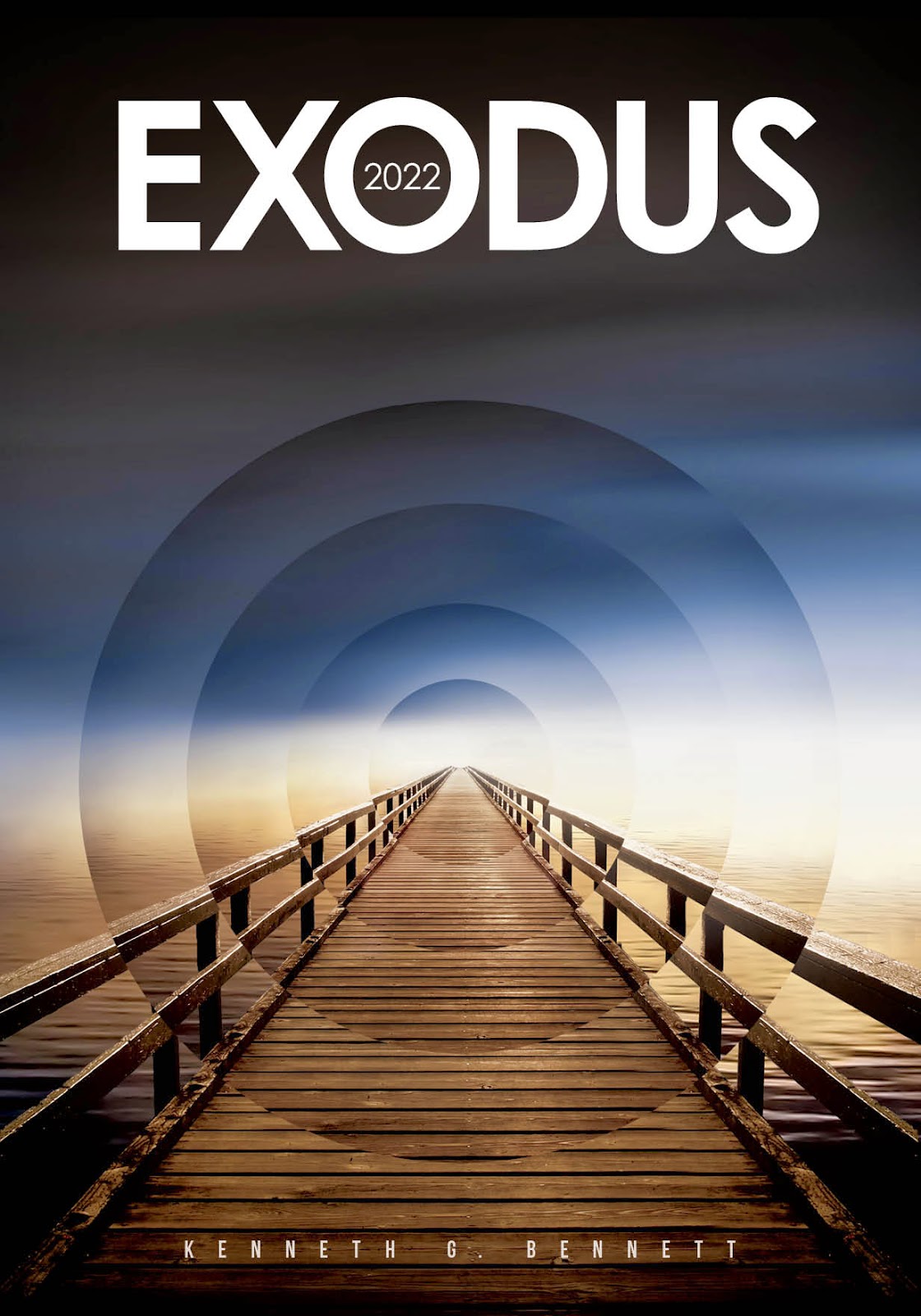
Exodus 2022 tour - Guest post by Kenneth G. Bennett

Today I'm pleased to have a guest stopping in. Fellow Booktrope author Kenneth G. Bennett is here as part of his Exodus 2022 tour. He'll be talking about how his story stands out. And make sure you scroll all the way to the bottom - where there'll be information about a cool giveaway.

So take it away, Kenneth.

Thank you for the opportunity to appear in a guest post on your blog! I really appreciate it.

Your question: “Describe how your story stands out,” is a tough one. I’m so close to the damn thing that it’s tough to answer with any objectivity. That said, I believe (hope) EXODUS 2022 might stand out for a few reasons:

  • The novel is a unique mix of genres: science fiction, fantasy, thriller, wilderness adventure and psycho-drama.
  • The pace is fast and relentless.
  • The story is different and (according to early readers) completely unpredictable.
Speaking of those wonderful early readers—I think this review on Amazon may answer your question more eloquently than I can:

Science fiction has been called the "literature of ideas" and I love SF novels that make me think. To me, the best SF uses advanced science or otherworldly elements to offer a new perspective on our own world. This is precisely what "Exodus 2022" does -- elegantly and without sacrificing a compelling plot nor fully-realized characters.

Without giving away the big mystery of the story (and it's a shocker), let's just say that author Kenneth Bennett weaves a fast-moving adventure tale filled with plot twists, vivid scenes full of drama and conflict, and sharply-drawn characters (including the tragic protagonist Joe Stanton, a man who starts off seemingly insane and hallucinating). But the real magic resonates within the themes and ideas of the novel. Quite simply "Exodus 2022" makes you think -- by positing a near-future where the link between humankind and the natural world is about to be changed forever.


If you like the classic sci-fi of the 1960s and 1970s (Bradbury, Heinlein, Asimov, Ellison, Dick, et. al.), grab a copy of "Exodus 2022" and prepare to go on a thinking-person's adventure. Better get, gather some like-minded sci-fi fans so you can all read and discuss this thought-provoking novel.

Thank you and best wishes,

Kenneth G. Bennett


Book details


Title: EXODUS 2022
Author: Kenneth G. Bennett
Genre: Sci-Fi Thriller (pre-apocalypse)
Audience: NA/Adult
Release date: May 20th, 2014
Publisher: Booktrope Publishing

Summary


Joe Stanton is in agony. Out of his mind over the death of his young daughter. Or so it seems.

Unable to contain his grief, Joe loses control in public, screaming his daughter’s name and causing a huge scene at a hotel on San Juan Island in Washington State. Thing is, Joe Stanton doesn’t have a daughter. Never did. And when the authorities arrive they blame the 28-year-old’s outburst on drugs.

What they don’t yet know is that others up and down the Pacific coast—from the Bering Sea to the Puget Sound—are suffering identical, always fatal mental breakdowns.

With the help of his girlfriend—the woman he loves and dreams of marrying—Joe struggles to unravel the meaning of the hallucination destroying his mind. As the couple begins to perceive its significance—and Joe’s role in a looming global calamity—they must also outwit a billionaire weapons contractor bent on exploiting Joe’s newfound understanding of the cosmos, and outlast the time bomb ticking in Joe’s brain. 


About the author


Kenneth G. Bennett is the author of the young adult novels, THE GAIA WARS and BATTLE FOR CASCADIA, and the new sci-fi thriller, EXODUS 2022. A wilderness enthusiast who loves backpacking, skiing and kayaking, Ken enjoys mysteries, science fiction, action adventure stories and, most especially, novels that explore the relationship between humans and the wild. He lives on an island in the Pacific Northwest with his wife and son and two hyperactive Australian Shepherds.

THE GAIA WARS series was optioned for film by Identity Films, LA in 2012, and both GAIA and BATTLE have been featured as Top 100 Bestsellers in Teen Literature and Fiction on Amazon. Kirkus Reviews called THE GAIA WARS “A solid first entry of a promising, imaginative new young-adult fantasy series featuring a well-crafted character.”

Links


Book links:
GR: https://www.goodreads.com/book/show/20641630-exodus-2022
LibraryThing: https://www.librarything.com/work/14672242
Shelfari: http://www.shelfari.com/books/37400967/Exodus-2022

Excerpt: http://www.kennethgbennettbooks.com/2014/01/26/EXODUS-2022-a-new-sci-fi-thriller-coming-may-2014/

Buy links:
Amazon: http://www.amazon.com/Exodus-2022-Kenneth-G-Bennett-ebook/dp/B00IRL8O2U/ref=sr_1_1?ie=UTF8&qid=1394549551&sr=8-1&keywords=exodus+2022

Author links:
website: http://www.kennethgbennettbooks.com
GR: https://www.goodreads.com/author/show/5131305.Kenneth_G_Bennett
Facebook: https://www.facebook.com/Exodus2022
Twitter: @kennethgbennett 

Giveaway 


Kenneth is offering the chance to win a Kindle Fire or 15 signed paperbacks. All you need to do is enter the giveaway below. Good luck.
  a Rafflecopter giveaway

Saturday, 19 April 2014

Lightness and melancholy

Today, I'm going to take one of my regular little excursions into the world of music.

I know - for someone who is supposed to be a writer, I seem to veer off into musical territory quite a bit. Truth is, I'd really love to be a muso. Unfortunately, a fairly complete lack of musical talent, coupled with a (supposed) talent in the writing area pushed me this way instead. Still, in my writing, I like to take inspiration from the musical side.

Anyway, the subject for this post was inspired by a music review a read in a newspaper a few years back. Can't remember what paper. Can't even remember what album (or band) was being reviewed. But it did make a point that has kind of stuck with me.

It talked about the idea of mixing lightness and melancholy to create music that was both engaging and bright while having a kind of inner depth. And it got me thinking about the kind of music I like, and how that is something I could say for a lot of it. Bands like Crowded House or R.E.M. (I know, I'm definitely showing my age and era) seemed to be masters of this style, making their music so engaging on so many levels. Even a supposedly hard rock band like Cold Chisel had an under-appreciated talent for mixing these two modes in a lot of their most enduring material.

Which leads back to the writing. I'm not sure it's particularly conscious but I can see how the lightness and melancholy thing fits a lot of my writing. Even though most of my writing could be broadly cast as humour, there is that somewhat melancholy thread to it.

I think particularly of the adventures of my good friend, Neville Lansdowne. He has odd adventures and meets very peculiar people. But there is another side to these stories as well. He's often alone, in strange and unfamiliar circumstances, particularly at the beginning. I think it's this touch of melancholy that adds a bit of depth and (dare I say) humanity to what would otherwise be strange and whacky stories.

I could apply this to other stories, such as Magnus Opum, where Magnus is struggling to understand the world he lives in, and who are and aren't his friends. He often feels sad and alone as he negotiates his adventure. And it's also there in my new picture book (out in just a few weeks) Thomas and the Tiger-Turtle. The turtle is both a comic figure but also at times a sad one too.

So there you have another one of my theories. Lightness and melancholy. It works a treat in music. And it's a really effective thing to include in a story as well. 

Saturday, 12 April 2014

What goes onto the back of the book?

One of the questions that we authors often face in interviews (or wherever) is "How long have you been a writer). For me, it's quite easy to answer. I actually have the evidence. Let me explain.

I started writing books when I was about five. I know, because I still have the books. Well, when I say "books" I mean pieces of paper stapled together, but for a five year old, I reckon that totally counts as a legitimate book.

I used to write books about everything. If I spent a day out at the park, I wrote a book about it. If I went on a family outing, I wrote a book about it. Whatever happened in my life would be the inspiration for a book (to be honest, I'm not sure things are any different now).

These books were generally scrawly drawn pictures (hey, I said I was a writer - I never said I was an artist) with a minimum of text (hey, I was five years old). However, there was one thing I always put a heap of effort into. The back covers.

Then (as now) I saw the back cover of my books as a wonderful marketing opportunity (not that I knew what marketing opportunities were back then). Inspired I think by Little Golden Books, I used to draw the covers of all my other books onto each back cover. Which ultimately led to a problems.

With every book that I wrote, I had more books I had to add to the back cover. But not only that. I also had to go back to every other book I'd written so I could add my new book to their back covers. This began to get pretty time-consuming. After a while, I think I was spending significantly more time updating back covers than I was writing new books. Some of the later books were barely more than two pages in length. I'm pretty sure this is what ultimately ended my first attempt at becoming a writer.

This came back to my recently, after I put out my last novella, Scrawling. Now being so aware of the potential for marketing in a book's back matter, I spent quite a bit of time not only placing information about my other books into it but also going back to the other books to add info about Scrawling. It gave me a very strange feeling of deja-vu.

Funny how the more things change, the more things stay the same.